

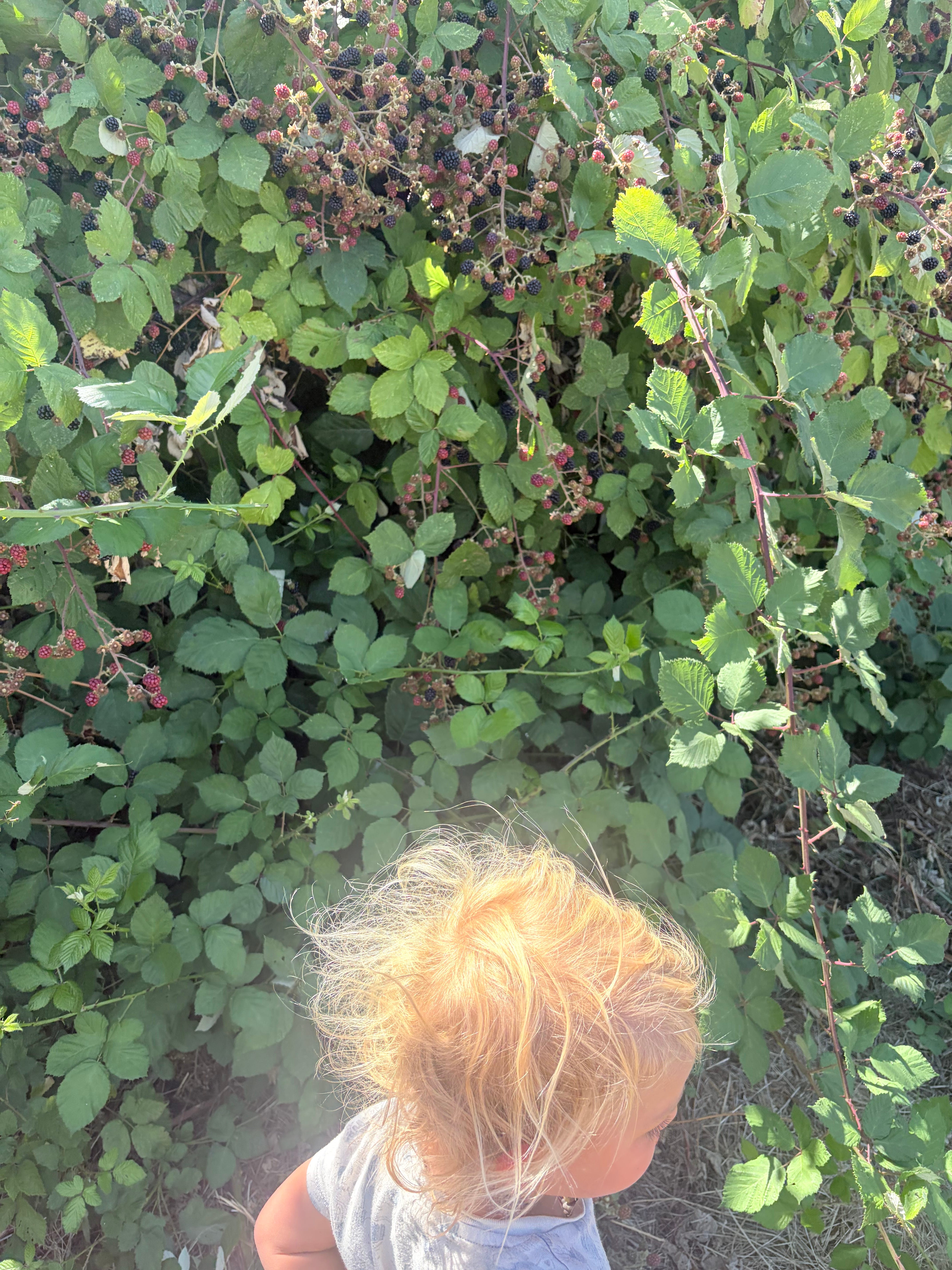
Nothing, not mushrooms, not ferns, not moss, not melancholy, nothing grew more vigorously, more intractably… than blackberries. Farmers had to bulldoze them out of their fields. Homeowners dug and chopped, and still they came back. Park attendants with flame throwers held them off at the gates. Even downtown, a lot left untended for a season would be overgrown. In the wet months, blackberries spread so wildly, so rapidly that dogs and small children were sometimes engulfed and never heard from again. In the peak of the season, even adults dared not go berry picking without a military escort. Blackberry vines pushed up through solid concrete, forced their way into polite society, entwined the legs of virgins, and tried to loop themselves over passing clouds.
– Tom Robbins, Still Life With Woodpecker
I.
We moved to the Willamette Valley at the peak of summer just before the blackberries begin to change color, as one invasive species among others. Oregonians will tell you as much. Californians and Himalayan blackberries have a lot in common: not from here, obnoxious, crowding out the good river spots. There is some truth to it. And the brambles are thick-caned and thorny and mean. They’re given to swallowing up fencerows and small trees, near impossible to kill without poison or a herd of goats. But in the last days of July they hang heavy with fat sweet berries hot from the sun, which is mostly enough redemption for me and more than enough for an eight-month-old.
That’s how old Eloise was then, too young to put words to what she wanted but old enough to eat berries as fast as I could gather them. By the end of a walk her face was stained dark as my hands. When the rains came at the end of September near her first birthday the fruit rotted and shriveled and the canes went bare, and she, who owned a few words by now, wailed black-ummms at every empty bush.
I had not given much thought to what a twelve-month-old understood about the world. But I started to then, and began to grasp that these walks were more than a sugar rush for her. Before she could walk or properly speak she had learned to recognize a particular plant, and around it she was building a world she will not remember and will never be rid of. When the fruit vanished she grieved it completely, because she had only ever known one summer. As far as she knew the blackberries were gone forever. The second realization arrived more slowly: the thing she treasured, most of the adults around her were trying to kill.
II.
In winter that year we found a place outside Eugene, thirteen and a half acres of rolling hills and a hundred-year-old farmhouse. The first thing I did was fence an area for the garden, and then I put pea gravel down for a little patio next to it. So Eloise spent that first winter in a full yellow rain suit, making stone soup from the gravel in her mud kitchen and coming back inside drenched regardless. And when spring rolled around we had plenty of greens growing and she would putter around ripping off pieces of lettuce and arugula. She’d present them to us and say Eat? and we would nod and she’d pop them in her mouth, scrunching her nose and spitting out the arugula when it was too spicy. She would look across the road and call to the sheep, which sounded an awful lot like she was hollering OHHH SHIT. We would laugh and she’d do it again. We got ducks and she would stand rapt as they waddled around and changed from chirpy yellow nervous things to a quacking herd, mottled black and white.
From the time she could walk she collected things. Rocks and sticks and maple leaves, acorns and oak galls and seashells and Queen Anne’s lace, which she called umbrella flowers. Her hauls piled up on the entryway floor, and most of them ended up painted.
III.
Eloise is four now, going on five. She understands that the bushes are barren in the winter and there is a golden quarter of the year when the blackberries riot. In the winter she asks when will they come back and I tell her Summer and she asks when’s Summer and I have to give her reference points. Mostly birthdays and things that we do. I show her the cow parsnips poking through the leaf litter in February and the buds breaking on the lilacs and tell her the nettles will pop up soon and it’ll be Mommy’s birthday, then it will be mine when the apple trees flower and we’ll plant the corn and squash and tomatoes, and then your brother Sam will turn two at the end of May when the rains peter out and the plants are pumping along and halfway through July your cousin Cormac will turn five and then we’re just about there. But she’ll never make it that far with the calendar intact. Somewhere in June the strawberries and raspberries will bury it, and she will forget the sogginess of February when all we can gather is the occasional sprig of lemon balm or some opportunistic field garlic pushing through while the grass does not grow.
An obscure English country priest named Thomas Traherne, remembering his own early childhood in the 1600s, wrote: the corn was orient and immortal wheat, which never should be reaped, nor was ever sown. I thought it had stood from everlasting to everlasting. That is the country my kids live in. We are here again at the peak of summer, and we still have to stop at every blackberry bush we pass. Sam has turned two and scarfs the berries even messier than his sister did. All July he feasted on unripe plums, gobbling them as fast as he could gather them from our tree, which hangs so heavy the limbs lie down on the ground like tired dogs. I don’t think he realized they’ll ripen. Now they are soft and purple and he savors them the same way.


IV.
Before Eloise was born, I wrote about shifting baseline syndrome. The idea is that your model of how the world should be gets fixed by the world you grew up in. And as humanity gnaws away the natural world in great chunks, every crop of children experiences a world less alive than the one before, and they understand this diminished reality as normal, having never known any different. So it ratchets down every generation, and nobody fights it, because what would they even be fighting for?
The freeway heading west from my old house in San Diego was a dirt road once. We bumped down it to the beach. I can still feel it in my molars. And though the road has been gone for decades, the freeway still feels wrong to me.
The syndrome is usually told as a story about loss, which it is. It is also, though nobody frames it this way, a story about leverage. The world’s texture consists not only of what the world contains, but of the attention you can bring to those things. A forest is one thing to a person who can read it and another thing entirely to a person who can’t (call it more world per acre).
This baseline sinks into a person in their first few years, and something will sink in whether you’re conscious of it or not. The leverage, then, is that I can see to it that the texture settling into the bones of my kids is a rich one. So much of parenting is outside your control, and there is enough poison drifting around to make you feel helpless. But to some extent you can direct the sensory environment they absorb. The one that’s going into Eloise on this hillside is one of black locust flowers from the church parking lot and lemon balm from the forest edge and green plums from a yard tree. Her normal will consist of finding food all over the place, where the year has a shape you can walk through and the plants have names.
Set that against the baseline most children are given now, where green spaces are only a blur out a car window, where their capacity to care is drained off to distant calamities that flicker across a screen. Children raised on that have nothing under them. Eloise will be harder to fool. She will notice when the old homestead orchard we glean apples from gets cut down. And because it is close, and in a meaningful sense hers, she might even be able to do something about it.
V.
Sometimes I forget I have a four-year-old and not a teenager with how she groans and complains. She tells us she wants to move back to California and live in the suburbs next to her grandparents. And now in the garden she has a strict policy against getting her hands dirty. I worry that it’s a preview of the larger rebellion to come, when she decides she dislikes everything I care about.
And yet, all the stuff I care about is already in there, wedged under the threshold of her memory, and she is stuck with it. She breaks off stalks of horsetail as we hike to make a “concoction” for her hair. She and Sam dig for clams in the flats near Florence and trudge back to the car soaking wet and smelling like fish. She makes hats from thimbleberry leaves and gets as excited as I do when the ornamental serviceberries planted in a parking lot turn out to be the best we’ve ever eaten. She eats her waffles with black walnut molasses from the green nuts we collect at the end of June, and if disaster strikes and twenty years from now she’s having breakfast in some small city apartment with maple syrup from Costco, I know it will not measure up.
Oh my, this makes me happy and mournful all in the same breath. What a beautiful capture of you and Bernie sharing your baseline loves and delights with Sam & Eloise