
Kill-Devil I: No Safe Amount
Part 1 of Essays on Alcohol and American Anxiety

This begins a series about America’s most persistent anxiety: what to do about alcohol. In the forthcoming essays I will dig into the ideological roots of today’s anti-drinking movement, untangle the confused research on alcohol, examine America’s loneliness epidemic, and make the case that what you drink matters as much as whether you drink (that there are practical differences between “natural” wine and your average $12 bottle Trader Joe’s).
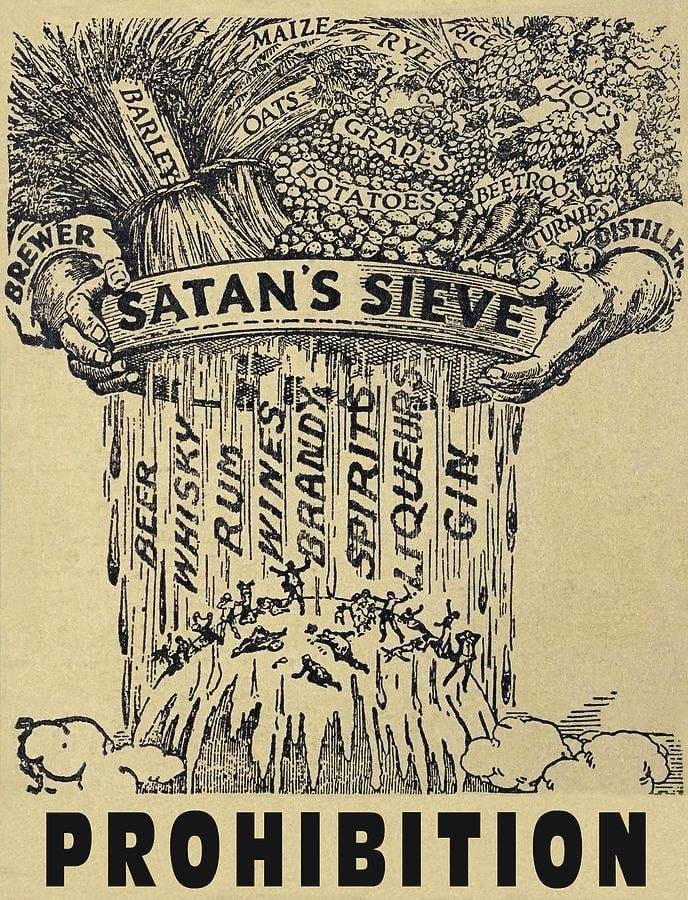
I.
There is no safe amount of alcohol.
At least that’s what the World Health Organization says.1 The US Surgeon General agrees. He wants cancer warnings on every bottle.2 And nearly 8 million people have watched Andrew Huberman explain in his aw shucks I’m just reading the science here tone that more than two drinks a week is playing with fire.3 The message is everywhere, crystal clear and authoritative and presented as settled science.
It’s also wrong. Wrong in its certainty, wrong in its framing, wrong in the way it flattens something incredibly complex with a rich ten thousand year human history into a simple calculation of cellular harm, and, if we’re being honest, probably wrong in that too.
The research is genuinely messy. Decades of studies show moderate drinkers outlive abstainers, and for awhile the verdict appeared to be set. One prominent researcher in the early 2000s compared skeptics of alcohol’s health benefits to flat-earthers.4 But some meta-analyses have emerged in the last few years that claim the benefits are illusory while the harms are real. Both sides throw around data that seems hard to argue with on the surface.
None of that nuance survives the journey to the general public, however. Instead it gets progressively filtered out by a series of institutional layers with different incentives, like a game of public health telephone, or the way sterile filtration strips the microbial life from a barrel of wine.
Some examples: Public health bureaucracies need clear population directives to justify their existence (you can’t move the statistical needle anywhere by saying it depends). Media outlets chase clicks, and fear and opinion seesawing sells better than complexity.5 A small handful of ideologically opposed researchers punch above their weight in shaping policy and perception (pick nearly any research paper that says alcohol is unequivocally bad for you and chances are you’ll find Tim Stockwell’s name on it).6 At the same time the wellness industry is forecast to hit $9 trillion by 2028. Perhaps cold plunging into a pool of Athletic Greens every morning skews your judgement, or perhaps they have non-alcoholic drinks to sell and a burgeoning market to carve out a piece of. Add to that neo-prohibitionist groups who have spent years on coordinated campaigns carefully designed to make drinking socially unacceptable and what crystallizes as public consensus is a warped reflection of the actual evidence.
Meanwhile the more interesting questions get buried. Does it matter what you’re drinking, cider made from wild apples and native yeast versus industrial vodka? Prohibition emerged as a global reaction to industrialization and the predatory liquor trade after all. And does the context matter, wine shared at a Georgian Supra versus unwinding with a couple glasses alone in your apartment after work?7 The same Surgeon General telling you that Pinot Noir causes cancer also declared that we have a loneliness epidemic in this country, and that social isolation is twice as deadly as heavy drinking.8 Can epidemiology measure the bonds that alcohol helps forge, or what’s lost when those bonds dissolve?
The current neo-Prohibitionist moment feels complete and inevitable, but so did all the others. We’ve accepted this new orthodoxy for the time being, but history says we’ll eventually abandon it with the same fervor we embraced it. Moderation has never satisfied the American need for moral clarity. We demand our lines drawn sharp and our choices absolute, and we’ve been cycling through this argument every generation since the first pilgrims stumbled off the Mayflower.
II.
Those pilgrims drank plenty but agonized about it all the while. The Puritan preacher Increase Mather called drink a good creature of God but in the same breath damned the drunkard as from the devil. They could never agree about where the good creature ended and where the devil began though, whether the sin was staggering around harassing your neighbors and smashing furniture or simply enjoying it too much. They banned toasts for a time because dudes kept trying to outdo each other. Shuffleboard went next, just to be safe. The line kept moving, or maybe it was never there to begin with, which didn’t stop them from insisting someone had crossed it.
Some warned of the slippery slope of swilling too much farmhouse cider while others claimed such a thing impossible. But all agreed rum was different. Lucifer’s bones dissolved with sugar in the wash, a catalytic element that transformed molasses into fire. They called it kill-devil. Picture Satan curled up and gleefully pickled at the bottom of the barrel, beckoning between hiccups for one more drop. Whether it killed the devil or turned one into him was never settled.9
We’ve inherited that legacy, that tendency to moralize while being drawn to excess. We still bicker about where the line should be. The Puritan spirit winds through American impulse, a particular kind of anxiety that has transmuted from hellfire sermons and temperance halls into biohackers and sleep scores. We are also a patchwork nation, stitched together from cultures that carried with them wildly different attitudes about drinking. German brewers, Irish whiskey-makers, Italian vintners, Evangelical teetotalers. Those seams remain, running along boundaries laid down centuries ago, religious and geographic and cultural fault lines that still shape where you can buy wine on Sunday and where you can’t buy it at all.10
III.
Formed by these disparate habits, early twentieth century America was a geography of contradictions. Local option laws let towns vote themselves into temperance while the next town over kept its saloons. More than half the nation already lived in dry territory by 1913, though it meant little when you could walk across the county line for a nip.
The porous checkerboard of wet and dry was more annoying than effective, and Wayne Wheeler understood its futility better than anyone. At age nine a drunk worker accidentally stabbed him with a pitchfork on his family’s Ohio farm. The wound scarred up into an absolute clarity regarding alcohol and its consequences, and by the time he ran the Anti-Saloon League a couple decades later he’d developed a theory of American democracy that few had articulated before: you didn’t need the majority if you had obsession. A small group that cared intensely about one cause and refused to compromise could overwhelm a diffuse majority and bend politicians to their will. Partial prohibition is like partial virginity, he liked to say. It doesn’t exist.11
What Wheeler assembled was less a coalition than a temporary convergence of grievances. The Women’s Christian Temperance Union had buried too many husbands gutted by whiskey, watched too many paychecks dissolve in saloons. Industrialists like Ford and Rockefeller knew exactly what Monday morning absenteeism and limbs mangled by heavy machinery cost per quarter. Phillies ballplayer turned revivalist Billy Sunday leapt up on pulpits and shadowboxed demons, frothing at massive crowds of the liquid devilry flowing through America’s veins. Whiskey and beer are all right in their place, but their place is in hell, he’d bellow.12 The KKK saw in temperance permission to do what they’d always wanted to do anyway under a banner of public morality. That is, terrorize Catholics and Jews whose drinking proved their moral inferiority. Progressive reformers joined in, convinced the saloon was capitalism’s trap for the working poor. Eliminate alcohol and society would have to create more wholesome public spaces. Then there were the proto-Hubermans like John Harvey Kellogg, who subjected his patients to yogurt enemas and breathwork and the cornflakes he invented to make people quit masturbating. He stood against tobacco, meat, tea, coffee, spices, and above all, alcohol. The man bundled his temperance with eugenics and breakfast cereal, and understood early on that Americans would embrace any deprivation if you gave it a scientific name and promised it would make them better than they were.
These groups agreed on nothing. Not suffrage, not race, not capital, not God. But Wheeler forged them into a political weapon aimed at their common enemy, a machine that produced the Volstead Act and a thirteen year experiment in banning booze at the federal level. It all came crashing down in 1933, but it lasted long enough to make bootleggers rich and corrupt every level of law enforcement. It also demonstrated beyond doubt that you can’t successfully outlaw a thing that large numbers of people very much want to do.
The temperance folks retreated, but they took notes. They’d return one day, armed with statistics and focus groups and a good deal more subtlety. Make drinking feel dangerous and backwards, then watch people police themselves.
Note that this is the former Surgeon General under the Biden administration, Vivek Murthy: https://www.nytimes.com/2025/01/03/health/alcohol-surgeon-general-warning.html
This has become a sort of litmus test for how I evaluate if news outlets are still worth reading. The New York Times and Washington Post in particular have devolved into piles of dogshit (at least when it comes to science writing, I have a cousin who works at the NYT who is publishing some great stuff and sorry Stefano if you’re reading this). The Atlantic still appears to produce some depth from time to time.
In an ironic turn of events, Stockwell is the same dude who compared alcohol health skeptics to flat-earthers. You could read this two ways, the first being he saw new evidence and changed his mind, the second being that he was corrupted by money or some other external influence. Seeing as he’s now funded by neo-prohibitionist groups like Movendi while the research itself hasn’t changed much, I tend to think it’s the latter.

It’s unclear why they actually called rum kill-devil. Some suggested it was due to the fact that it was a devil that killed many people, although as far back as the 16th century Christopher Marlowe references it as someone who has killed the devil. In The Tragical History of Doctor Faustus: “ … and I’ll knock them, they were never so knocked since they were devils! Say I should kill one of them, what would folks say? “Do ye see yonder tall fellow … – he has killed the devil.” So I sould be called Kill-devil all the parish over.” For more on the etymology read this essay series exploring the topic: https://bar-vademecum.eu/rum-and-kill-devil-a-new-etymology-part-2-etymology-so-far/
This is explored in more detail in Colin Woodard’s American Nations: A History of the Eleven Rival Regional Cultures of North America. Woodard’s central thesis says that the U.S. is functionally divided into eleven distinct “stateless nations,” each founded by a specific ethno-religious group with unique beliefs about governance, liberty, and morality. It seems a little crazy on the surface, but I think the framework is a useful lens for looking at enduring regional cultural and political dynamics. The resulting patchwork of regional alcohol laws and attitudes is a direct manifestation of this. Specifically, Woodard identifies a clash between the North’s reformist impulse (especially Yankeedom, which historically drove the Temperance Movement and National Prohibition) and the cultural zones of the Deep South and Appalachia, where opposition to alcohol is rooted in religious fundamentalism and the desire for localized moral control (leading to dry counties and local option laws). These contrasting regional impulses continue to shape state and municipal legislation regarding alcohol sales and consumption.
Wheeler is often credited as the main pioneer of pressure politics
In an odd turn of events, he owned an orchard in Hood River, OR, which is the promised land as far as cider-making out west is concerned, so I feel a strange connection to the guy.
Fantastic article, Andrew. I was just going to ask if you'd heard of Scruton's wine book but saw my brother Mericos beat me to it. Here's a bit from it:
"We are familiar with the medical opinion that a daily glass or two is good for the health, and also with the rival opinion that any more than a glass or two will set us on the road to ruin. Such counsels are important, though less important than they seem. Whatever the effect of wine on physical health, it has far more significant effects on mental health - both negative, when detached from the symposium culture, and positive, when joined to it. Already in America (in many parts of which the age of consent for alcohol is five years on from the age of consent for sex) wine bottles have to be marked with a health warning. If the purpose is to educate the public, then all well and good, provided the warning tells the truth (which it doesn't). But the same educative goal ought to persuade us to put health warnings on bottled water too, reminding us of the dreary states of mind that come from drinking it, of the need to take time off from hypochondria in order to give food and drink to the soul, and of the ecological madness of transporting around the world in bottles, the stuff that rains from above us and flows beneath our feet."
Gagimarjos my good man. Still chuckling at "The line was never there to begin with but that never stopped them from accusing each other of crossing it." So true.
Have you read this?:
https://www.amazon.com/Drink-Therefore-Am-Philosophers-Guide/dp/1472969871